
Trigonometry for Complete Beginners
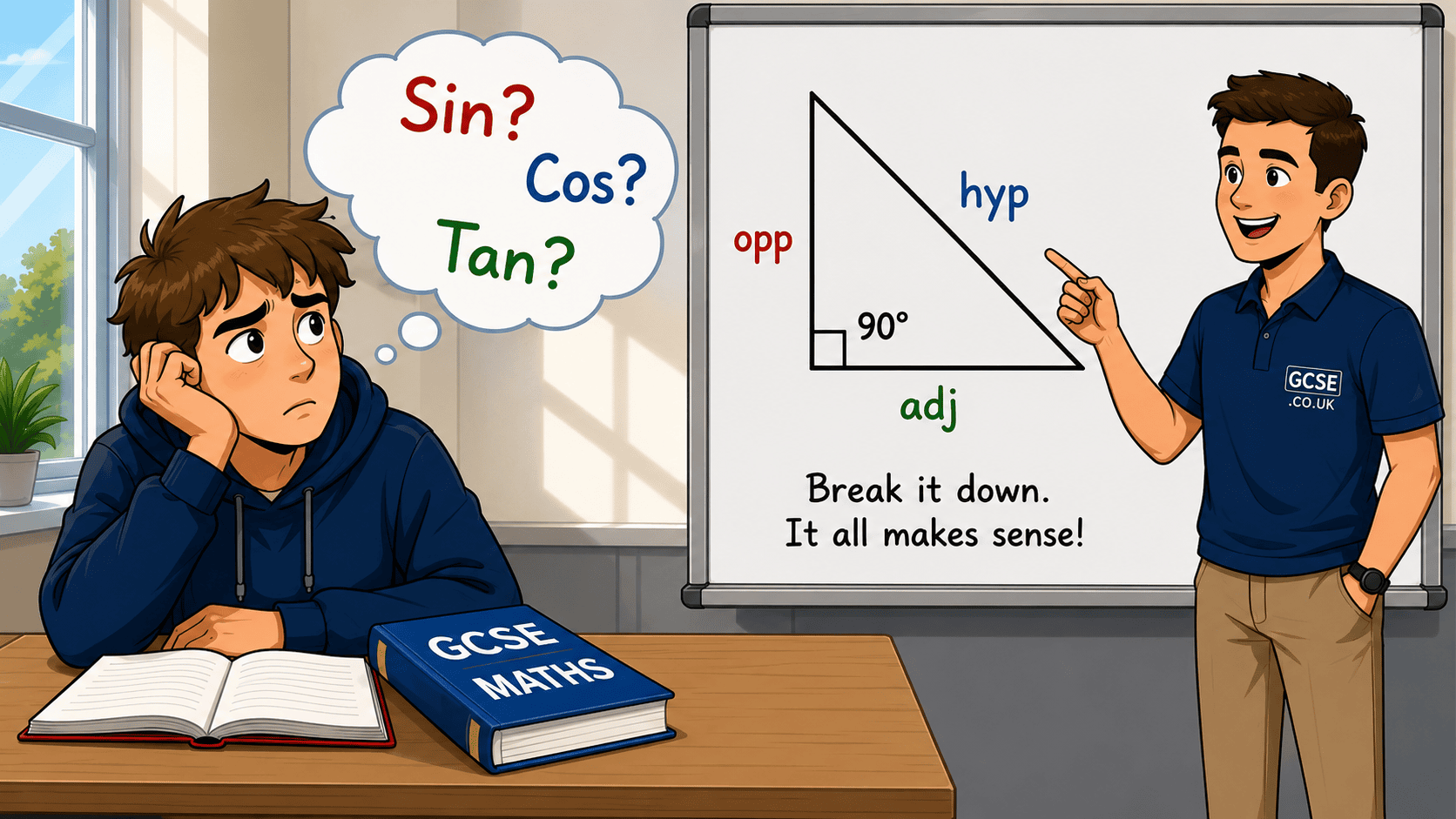
Trigonometry is one of those topics that often sounds far more complicated than it really is. Many students hear words like sine, cosine and tangent and immediately think they need to memorise lots of confusing formulae.
The good news is that trigonometry is actually built on one very simple idea.
If you understand that one idea, the rest begins to make sense.
Rather than memorising rules, this lesson will help you understand why trigonometry works. Once you understand the reasoning, remembering the mathematics becomes much easier.
Learning Objectives
By the end of this lesson you should be able to:
- Recognise a right-angled triangle.
- Identify the hypotenuse, opposite and adjacent sides.
- Understand what sine, cosine and tangent actually represent.
- Use SOHCAHTOA to choose the correct trigonometric ratio.
- Calculate missing sides using a calculator.
- Calculate missing angles using inverse trigonometric functions.
- Recognise common GCSE mistakes and know how to avoid them.
What Is Trigonometry?
Imagine standing outside a building.
You know you are exactly 12 metres away from it.
You look up to the roof and measure the angle between the ground and your line of sight.
Without climbing the building or using a tape measure, could you work out how tall it is?
Surprisingly, yes.
That is exactly the sort of problem trigonometry was invented to solve.
Trigonometry is the branch of mathematics that studies the relationship between angles and side lengths in triangles.
It allows us to calculate measurements that would otherwise be difficult, expensive or even dangerous to measure directly.
Think of It Like This
Imagine enlarging a photograph on your computer.
The picture becomes bigger, but its shape does not change.
The same thing happens with right-angled triangles.
Two triangles can be completely different sizes, but if one of their angles is the same, the proportions between their sides stay exactly the same.
Those fixed proportions are what trigonometry measures.
The Right-Angled Triangle
Everything you learn in GCSE trigonometry starts with one special shape:
the right-angled triangle.
A right-angled triangle always contains one angle measuring exactly 90°.
In diagrams, this angle is shown by a small square in the corner.
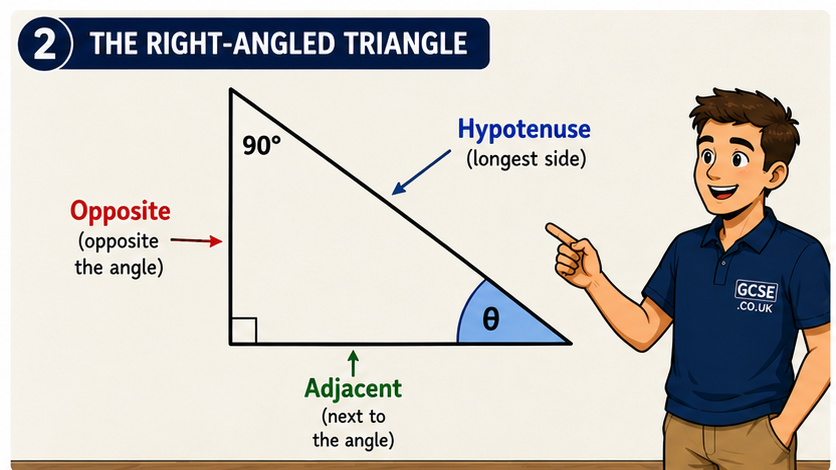
Every right-angled triangle has three sides.
These sides have special names.
Key Terminology
- Hypotenuse – the longest side. It is always opposite the 90° angle.
- Opposite – the side directly opposite the angle you are using.
- Adjacent – the side next to the angle you are using (but not the hypotenuse).
The hypotenuse never changes.
However, the opposite and adjacent sides do change depending on which angle you are looking at.
A Very Common GCSE Mistake
Students often think that the opposite side and adjacent side have fixed positions.
They do not.
Their names depend entirely on the angle you are working from.
Always identify the angle first.
Only then should you label the three sides.
Why Trigonometry Works
At first glance, trigonometry can seem like a collection of random rules.
It is actually based on one beautifully simple fact.
If two right-angled triangles contain the same angle, then the ratio between corresponding sides will always be identical.
The triangles may be tiny.
They may be enormous.
One could fit on a page while another could represent the side of a mountain.
It does not matter.
If the angle stays the same, the ratios stay the same.
Example
Suppose one triangle has:
- Opposite side = 3 cm
- Hypotenuse = 5 cm
The ratio is:
3 ÷ 5 = 0.6
Now imagine a much larger triangle with exactly the same angle.
- Opposite side = 30 cm
- Hypotenuse = 50 cm
The ratio is still:
30 ÷ 50 = 0.6
The numbers became larger, but the ratio stayed exactly the same.
That simple observation is the entire foundation of trigonometry.
Introducing Sine, Cosine and Tangent
Now that you understand why these ratios stay constant, we can finally answer the question:
What are sine, cosine and tangent?
They are not mysterious mathematical tricks.
They are simply names given to three different ratios inside a right-angled triangle.
Each one compares two sides.
Each one answers a different question.
The Three Questions
- Sine asks: "How does the opposite side compare with the hypotenuse?"
- Cosine asks: "How does the adjacent side compare with the hypotenuse?"
- Tangent asks: "How does the opposite side compare with the adjacent side?"
Once you know which two sides you have, choosing the correct trigonometric ratio becomes much easier.
Understanding Sine
Let's start with the first trigonometric ratio: sine.
Sine compares the opposite side with the hypotenuse.
Written as a formula:
Sine = Opposite ÷ Hypotenuse
At first, this might look like another formula to memorise, but try to think about what it is really asking.
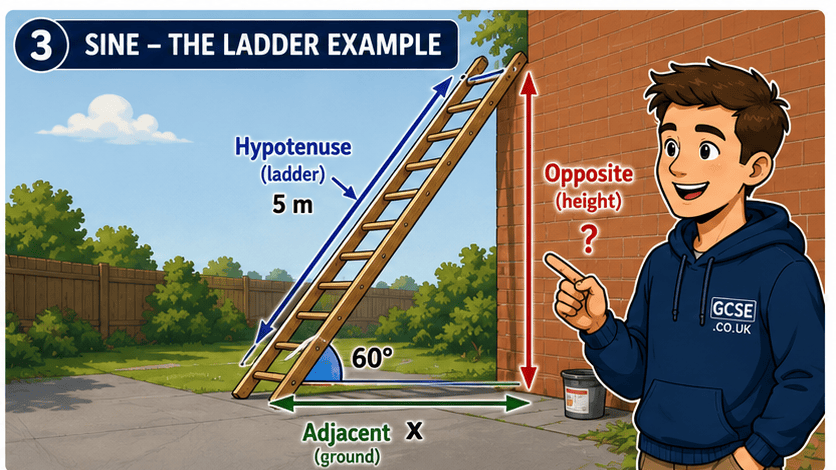
Imagine a ladder leaning against a wall.
The ladder forms the longest side of the triangle, so it is the hypotenuse.
The height the ladder reaches up the wall is the opposite side.
Sine simply tells us what fraction of the ladder's length becomes vertical height.
Worked Example
A ladder is 5 metres long.
It makes an angle of 60° with the ground.
How high up the wall does it reach?
Step 1: Identify the sides.
- Hypotenuse = 5 m
- Opposite = ?
- Angle = 60°
Step 2: Choose the correct ratio.
We have the opposite side and the hypotenuse.
That means we use sine.
Step 3: Write the equation.
sin 60° = Opposite ÷ 5
Step 4: Rearrange.
Opposite = 5 × sin 60°
Step 5: Use your calculator.
sin 60° ≈ 0.866
Opposite = 5 × 0.866
Opposite ≈ 4.33 metres
GCSE Calculator Tip
Before using any trigonometry, always check that your calculator is set to Degrees (DEG), not Radians (RAD).
Most GCSE questions use degrees.
If your calculator is in the wrong mode, every answer will be incorrect, even if your method is perfect.
Understanding Cosine
Cosine compares the adjacent side with the hypotenuse.
Cosine = Adjacent ÷ Hypotenuse
Instead of measuring height, cosine measures how much of the triangle extends along the ground.
Let's use exactly the same ladder.
This time we are not interested in how high it reaches.
Instead, we want to know how far the bottom of the ladder is from the wall.
Worked Example
The ladder is still 5 metres long.
The angle with the ground is still 60°.
This time we need the adjacent side.
cos 60° = Adjacent ÷ 5
Adjacent = 5 × cos 60°
cos 60° = 0.5
Adjacent = 5 × 0.5
Adjacent = 2.5 metres
Notice something interesting.
The ladder has not changed.
The angle has not changed.
The only thing that changed was the question.
Sine found the height.
Cosine found the distance along the ground.
Understanding Tangent
Tangent is slightly different.
Unlike sine and cosine, it does not involve the hypotenuse.
Tangent = Opposite ÷ Adjacent
Tangent compares the height with the horizontal distance.
This makes it especially useful when measuring how steep something is.
Road engineers, builders and surveyors use tangent every day.
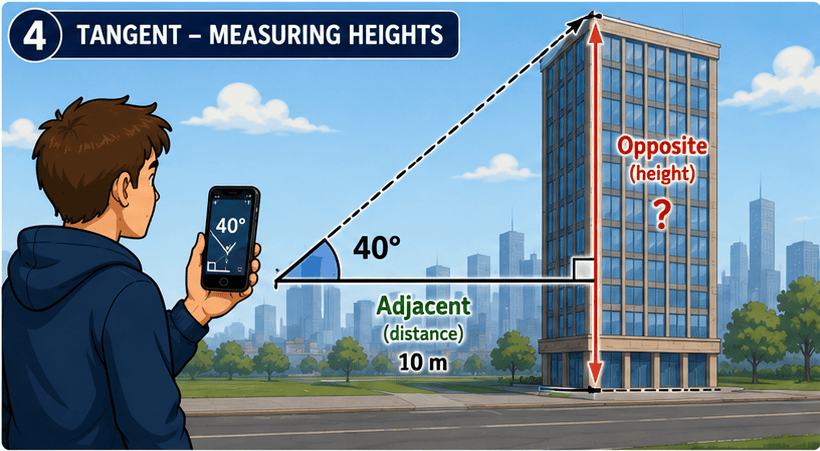
Worked Example
You stand 10 metres from a building.
The angle from the ground to the top is 40°.
How tall is the building?
Known:
- Adjacent = 10 m
- Opposite = ?
- Angle = 40°
Use tangent.
tan 40° = Opposite ÷ 10
Opposite = 10 × tan 40°
tan 40° ≈ 0.839
Opposite = 10 × 0.839
Building height ≈ 8.39 metres
SOHCAHTOA — A Memory Aid, Not a Magic Formula
You have probably heard the strange word SOHCAHTOA.
Many students try to memorise it without understanding what it means.
That usually works until the exam question changes slightly.
Instead, think of SOHCAHTOA as a quick reminder of the three ratios you have already learned.
SOHCAHTOA
- SOH → Sine = Opposite ÷ Hypotenuse
- CAH → Cosine = Adjacent ÷ Hypotenuse
- TOA → Tangent = Opposite ÷ Adjacent
Rather than asking yourself, "Which formula do I remember?", ask yourself:
- Which side do I already know?
- Which side am I trying to find?
- Which trigonometric ratio connects those two sides?
If you answer those three questions first, SOHCAHTOA becomes a simple checking tool instead of something that has to be memorised.
Finding Missing Angles Using Inverse Trigonometry
So far, every example has started with a known angle and used it to calculate a missing side.
However, GCSE questions often work the other way around.
Sometimes you already know two side lengths and need to calculate the missing angle.
This is where inverse trigonometric functions are used.
Most scientific calculators have three additional buttons:
- sin-1
- cos-1
- tan-1
These buttons work in the opposite direction.
Instead of taking an angle and giving you a ratio, they take a ratio and return the angle.
Think of It Like Rewinding a Film
Imagine watching a football match.
Normally you watch events moving forwards.
Press the rewind button and everything happens in reverse.
Inverse trigonometric functions do exactly the same thing.
Instead of travelling from an angle to a side length, they travel from side lengths back to the angle.
Worked Example
A wheelchair ramp rises 1.5 metres over a horizontal distance of 4 metres.
Calculate the angle of the ramp.
Step 1: Label the sides.
- Opposite = 1.5 m
- Adjacent = 4 m
Step 2: Choose the correct ratio.
We have the opposite side and the adjacent side.
Therefore, we use tangent.
Step 3: Find the ratio.
tan θ = 1.5 ÷ 4
tan θ = 0.375
Step 4: Use the inverse tangent button.
θ = tan-1(0.375)
θ ≈ 20.6°
Exam Tip
If the question asks for an angle, remember to use the inverse button on your calculator.
This is one of the most common mistakes made in GCSE examinations.
Choosing the Correct Trigonometric Ratio
One of the biggest challenges for beginners is deciding whether to use sine, cosine or tangent.
Fortunately, there is a simple process that works every time.
Five-Step Method
- Draw or study the triangle carefully.
- Identify the angle you are working from.
- Label the hypotenuse, opposite and adjacent sides.
- Decide which side you know and which side you need.
- Select the ratio that links those two sides.
If you follow these five steps, you will rarely choose the wrong trigonometric function.
Real-Life Applications of Trigonometry
It is easy to wonder whether trigonometry is only useful for passing GCSE Maths.
In reality, it is used in many different careers and technologies.
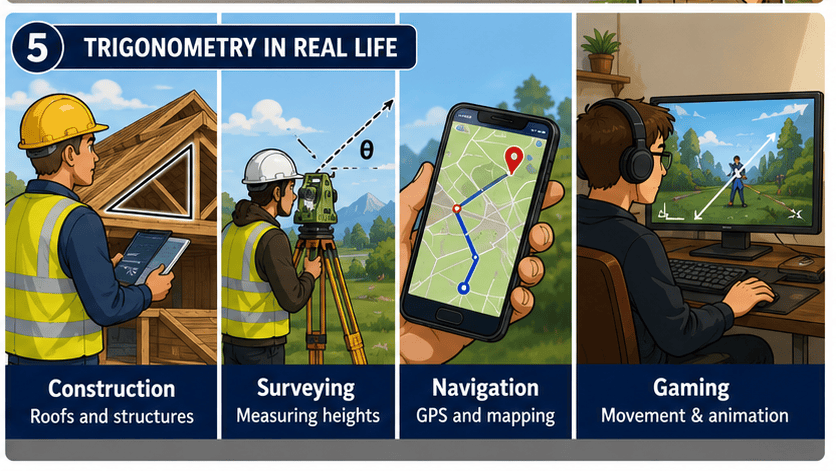
Construction
Builders use trigonometry when designing roofs, staircases and bridges.
Knowing one angle and one length allows them to calculate every other measurement accurately.
Surveying
Surveyors calculate the heights of buildings, towers and hills without climbing them.
They simply measure an angle and a known distance from the object.
Satellite Navigation
Your phone constantly performs calculations involving triangles to estimate your position.
Although the mathematics is much more advanced than GCSE level, it is based on exactly the same ideas.
Computer Games
When a character moves diagonally across the screen, computer code often uses sine and cosine to split that movement into horizontal and vertical directions.
Smooth animation depends heavily on trigonometry.
Common GCSE Mistakes
Mistake 1 – Labelling the Triangle Incorrectly
The opposite and adjacent sides change depending on the angle.
Always identify the angle first.
Mistake 2 – Using the Wrong Ratio
Do not automatically choose sine because it is the first function you learned.
Choose the ratio that connects the two sides involved in the question.
Mistake 3 – Forgetting Degree Mode
Always check your calculator before starting.
If your calculator is set to radians, your answers will be incorrect.
Mistake 4 – Forgetting the Inverse Function
If the question asks for an angle, remember to use sin-1, cos-1 or tan-1.
Mistake 5 – Applying SOHCAHTOA to the Wrong Triangle
SOHCAHTOA only applies to right-angled triangles.
If there is no 90° angle, GCSE students must use different methods, such as the Sine Rule or Cosine Rule, which are studied separately.
GCSE Exam Advice
How Examiners Award Marks
- Label your triangle before beginning.
- Write the trigonometric ratio you are using.
- Show every stage of your working.
- Do not round values too early.
- Round your final answer to the number of decimal places requested in the question.
Even if your final answer is incorrect, you can often earn method marks by showing the correct process.
Practice Questions
Easy
- A right-angled triangle has an angle of 30° and a hypotenuse of 12 cm. Calculate the length of the opposite side.
- A right-angled triangle has an angle of 45° and a hypotenuse of 16 cm. Calculate the length of the adjacent side.
- Explain, in your own words, what the hypotenuse is.
Medium
- You stand 15 metres from a flagpole. The angle of elevation to the top is 38°. Calculate the height of the flagpole.
- A ladder 6 metres long leans against a wall at an angle of 70°. Calculate how high it reaches.
- A right-angled triangle has an opposite side of 9 cm and an adjacent side of 14 cm. Calculate the angle.
Challenge
- A tree casts a shadow 11.5 metres long. The angle of elevation of the Sun is 53°. Calculate the height of the tree.
- A wheelchair ramp rises 0.9 metres over a horizontal distance of 3.4 metres. Is the ramp angle greater than or less than 15°?
- Without using SOHCAHTOA, explain why two right-angled triangles with the same angle always have the same trigonometric ratios.
Revision Summary
Remember These Key Ideas
- Trigonometry only applies to right-angled triangles.
- The hypotenuse is always opposite the 90° angle and is always the longest side.
- The opposite and adjacent sides depend on the angle you are using.
- Sine compares the opposite side with the hypotenuse.
- Cosine compares the adjacent side with the hypotenuse.
- Tangent compares the opposite side with the adjacent side.
- SOHCAHTOA is a memory aid that reminds you which ratio uses which sides.
- Always label the triangle before choosing a trigonometric ratio.
- Check that your calculator is in Degree (DEG) mode.
- Use the inverse trigonometric functions when calculating missing angles.
What to Study Next
Now that you understand the basic trigonometric ratios, you are ready to move on to more advanced GCSE topics.
- Finding missing sides in right-angled triangles.
- Finding missing angles in right-angled triangles.
- Three-dimensional trigonometry.
- The Sine Rule.
- The Cosine Rule.
- Using trigonometry to solve real GCSE examination problems.
As your confidence grows, you will discover that trigonometry is not a collection of difficult formulae. It is simply a logical way of describing the relationships between the sides and angles of right-angled triangles.